Marshall Meyer, Ph.D.
Psychoanalysis
I am a lecturer in Film and Television Studies at the University of Vermont, as well as a candidate psychoanalyst in private practice in the tradition of Freud and Lacan. Unlike a psychotherapist, I am interested in the unconscious, a deep recess in the mind that makes itself felt primarily through dreams, slips of the tongue, fantasies, and symptoms. My work is guided by the conviction that much of our singularity, as well as much of our suffering, comes from this part of our mind and the repetitions it causes us to live out.


What Psychoanalysis Looks Like
Free association allows us to sneak up on the unconscious, as it were, confronting unconscious conflict and leading to profound, lasting change in one's psychic economy and one's relationship to life itself. I employ Lacan's variable-length session, which means that sessions are often shorter than those in conventional therapy. The goal is to end the session not at a particular time but on a particular thought, so that the thought will resonate during the time leading up to our next session.
Undergoing an analysis can be difficult and requires genuine curiosity about your past, identity, and motivations, and many who choose to do so have found other treatment modalities ineffective. Psychoanalysis works best when we can meet often, ideally at least two or three times per week. I work over the phone with patients anywhere in California.
Details
Fee
Sliding scale (please email me and propose a fee that is meaningful to you based on your circumstances)
Insurance
I do not accept health insurance. However, I can provide patient superbills, which you may then submit to your healthcare provider for a reimbursement if you have out-of-network coverage.
Session Length
Variable length (see above)
Frequency
We meet as often as the patient is able to. However, an intensive psychoanalysis usually meets 2-3 times per week, sometimes more.
Location
I work over the phone with residents anywhere in California.
License
California SRP #402
My Background
I have a PhD in the humanities from Johns Hopkins University, where I was able to complete some coursework at the medical school. I am a Candidate Analyst at the Lacanian School of Psychoanalysis, which I have been a member of since 2021. I have also received training from GIFRIC in Quebec and the École normale supérieure in Paris.
My CV, which includes a list of publications as well as university courses I have taught, is available here.
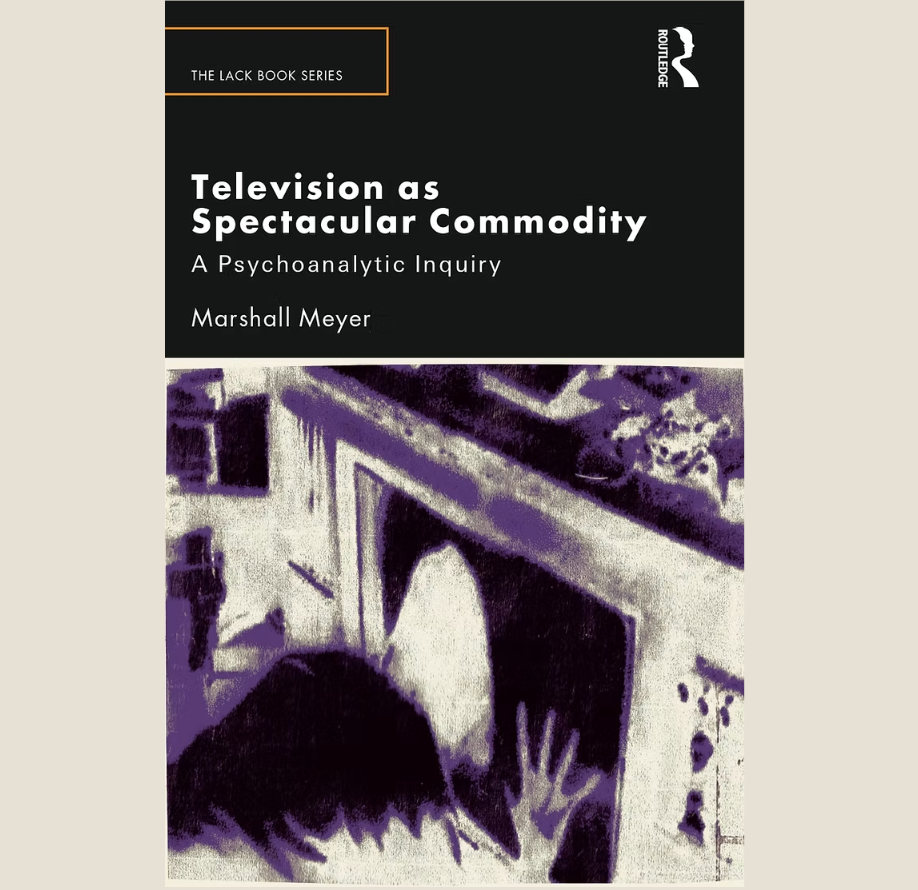
Television as Spectacular Commodity
My first book, Television as Spectacular Commodity: A Psychoanalytic Inquiry, which will be released in December 2026 through Routledge's new LACK Book Series, is a work of media studies that adapts the past half-century of psychoanalytic film theory to the medium of television. It demonstrates how certain works of art, in particular audiovisual narratives like TV and film, emulate the effects of the psychoanalytic cure, thereby giving new meaning to the commonplace understanding of art as therapeutic. The book also situates the enjoyment on offer from these rare, spectacular commodities as diametrically opposed to that which sustains the capitalist mode of production.
Praise for Television as Spectacular Commodity
"There are many books which combine two different domains of theory (like philosophy and psychoanalysis) and thereby produce a path-breaking new insight. Meyer’s Television as Spectacular Commodity goes a step further and combines three domains: psychoanalytic theory, the Marxist notion of commodity fetishism, and an analysis of new trends in TV series. The result of this combination is an explosion of insights: the Marxist notion of commodity fetishism throws a new light on psychoanalytic processes as well as on TV series, and top quality TV series are analyzed as exercises in serious thinking, not just as amusement. In short, our entire understanding of contemporary society is shattered. Meyer’s clearly written book should reach a wide public not only in the humanities but among all those who want to understand the world we live in. If it does not become an instant classic, then we live in a world from which human spirit has disappeared."
—Slavoj Žižek
"Psychoanalysis has always seemed intrinsically drawn to film, undoubtedly because of the link between movies and dreams. But television has proven resistant to psychoanalytic interpretation until recently. In a movement in which Marshall Meyer plays a leading role, television becomes not just an object for psychoanalytic inquiry that allows us to understand works from contemporary cringe comedy to the best of prestige television. It also serves as a site for Meyer to develop new formulations of seemingly tired psychoanalytic concepts, such as the death drive and enjoyment. These concepts bring television alive as a theoretical medium, while television revitalizes the psychoanalytic approach. For all television spectators, Meyer has constructed a masterpiece not to be missed. I will never look at a television series the same way again, and neither will anyone else who reads this breakthrough work."
—Todd McGowan
Contact
